Core Technology
Surface Energy Gradient Coatings
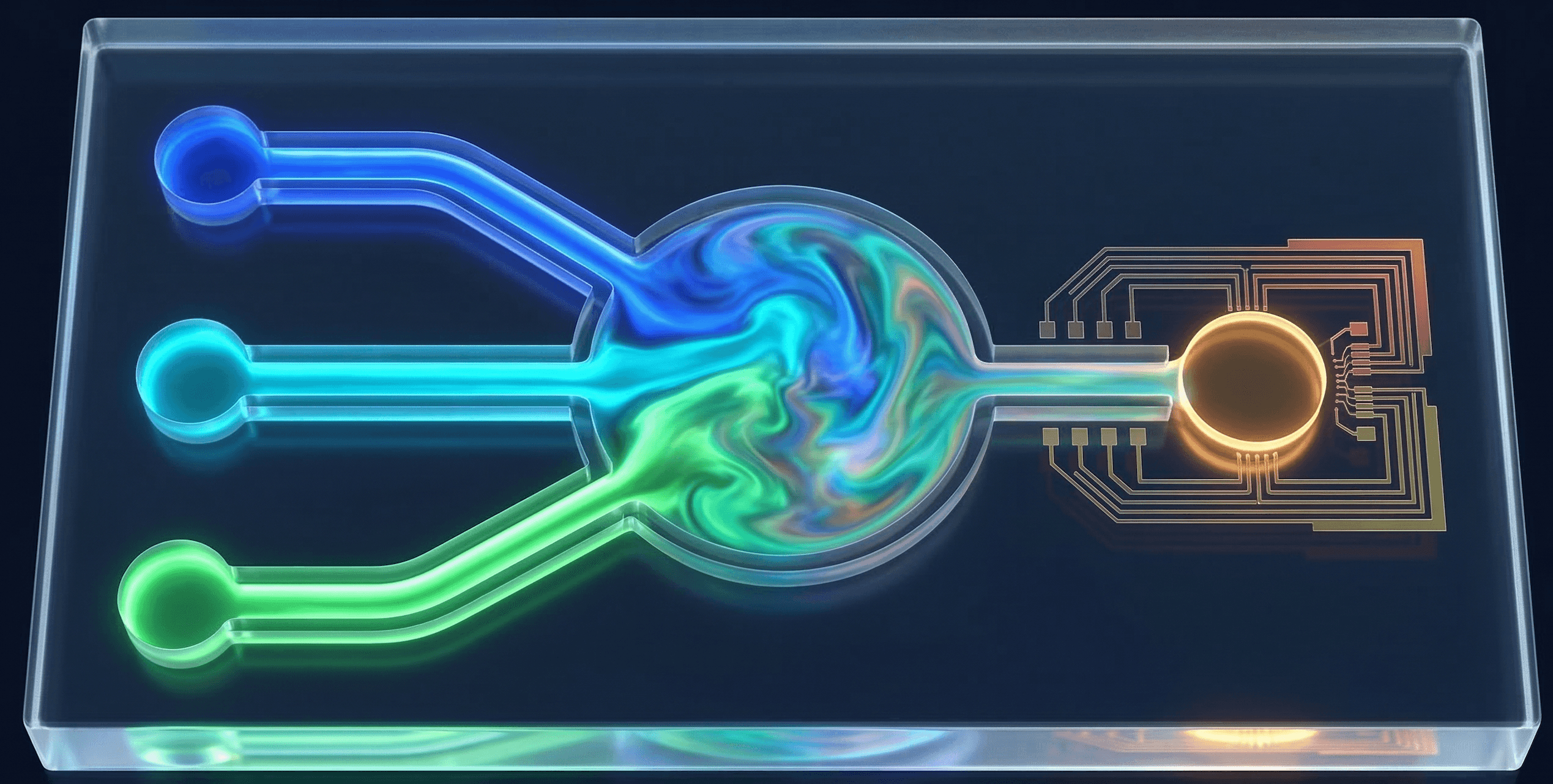
A patented platform technology that generates a net capillary force inside microfluidic channels — moving liquids passively without pumps, valves, or any external power source.
Core Technology
A patented platform technology that generates a net capillary force inside microfluidic channels — moving liquids passively without pumps, valves, or any external power source.
The Mechanism
Every liquid has a contact angle with every surface — the angle at which the liquid-vapor interface meets the solid surface. When this angle is high, the surface resists wetting. When it is low, the surface attracts the liquid.
Surnetics coatings create a precise, continuous gradient in this contact angle along the channel wall — from a high contact angle at one end to a low contact angle at the other. This asymmetry in wettability creates an unbalanced capillary force.
The result: the liquid experiences a net force toward the low-contact-angle end and self-propels — without any pump, wicking material, or external energy input. The velocity and stopping point are determined entirely by the coating design.
Surnetics is the only company that can offer this technology commercially.
Gradient Channel Cross-Section
Competitive Position
Surface Energy Gradient Coating technology is protected by an active US patent portfolio. No other company can commercialize this approach. Partners gain exclusive access to a patented platform with a 2041 protection horizon.
Liquid is driven through microchannels by the surface energy gradient alone — no pump, no pressure source, no wicking strip required.
Multiple independent flow rates on a single device layer. Different channels can be tuned to different velocities without valves or electronics.
Flow velocity is precisely controlled by adjusting the gradient coating composition — enabling exact flow parameters for each application.
The coating can be engineered to stop and restart fluid flow at defined locations — no valve required to hold or release a sample.
Substrate Compatibility
Gradient coatings have been successfully developed and validated on a wide range of substrate materials used in microfluidic device manufacturing.
Characterization
Full characterization of gradient coatings from surface energy profiling to molecular spectroscopy ensures each coating meets precise performance specifications.
Working With Us
A structured engagement process from initial technical assessment through full-scale manufacturing transfer.
01
We evaluate your microfluidic design, substrate materials, and flow requirements against our coating portfolio. Includes contact angle testing and flow characterization.
02
Custom gradient formulation and deposition process development for your specific channel geometry, materials, and flow targets. Full analytical characterization.
03
Functional prototype devices with gradient coatings. Flow performance validation, repeatability testing, and design iteration.
04
Process transfer to high-volume production. Compatible with standard microfluidic manufacturing processes and equipment.